





Details
3
0
Save
Authored by Mr. Marc Salameh
10 minutes
Aug 24, 2026


Authored by Mr. Marc Salameh
Visual impairment affects millions of individuals worldwide and significantly impacts independent mobility, safety, and access to daily activities. While traditional white canes remain an essential mobility aid, they provide limited environmental awareness and often fail to address challenges such as head-level obstacles, emergency situations, caregiver connectivity, and real-time location awareness.
As technology continues to evolve, there is an opportunity to enhance traditional mobility tools through affordable and practical digital innovation.
Li-Stick was created to address these challenges. Developed at the Holy Spirit University of Kaslik (USEK), Li-Stick is an assistive technology platform designed to improve the safety, independence, and confidence of visually impaired individuals.
What began as a final-year engineering project evolved into an innovation initiative focused on creating a scalable, user-centered mobility solution that combines embedded intelligence, connectivity, caregiver support, and future artificial intelligence capabilities.
This case study presents the evolution of Li-Stick from its initial concept to its current Minimum Viable Product (MVP), highlighting the technical architecture, design decisions, challenges encountered, and lessons learned throughout the development process.
The development of Li-Stick was driven by a simple but important question: How can technology improve the mobility experience of visually impaired individuals without making the solution overly complex, expensive, or dependent on continuous internet connectivity?
Initial discussions with visually impaired users revealed several recurring concerns. Traditional mobility aids provide limited awareness of obstacles beyond ground level, offer no mechanism for emergency communication, and do not allow caregivers to monitor or assist users remotely when needed.
Additionally, many existing smart cane solutions available internationally remain expensive and difficult to adapt to local markets.
These observations established the foundation of Li-Stick. Rather than replacing the traditional cane, the goal became enhancing it through practical technology that could increase safety while remaining intuitive and accessible.
The first generation of Li-Stick focused on validating core concepts. The primary objective was to determine whether a smart mobility cane could successfully detect obstacles, provide tactile feedback, and establish basic communication between the user and a caregiver ecosystem.
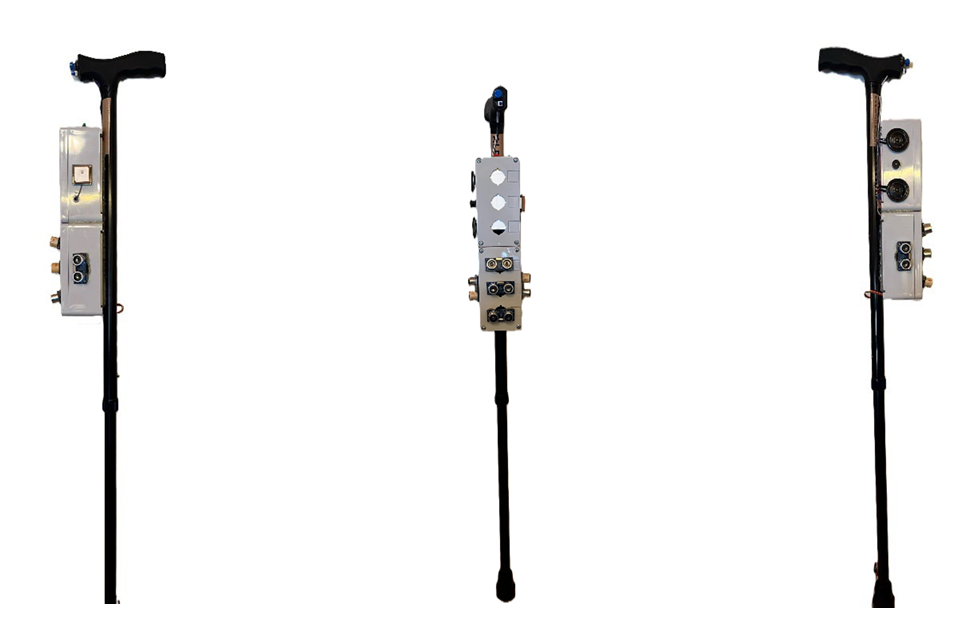
The initial prototype demonstrated that obstacle detection, emergency alerts, and mobile connectivity could be integrated into a single platform.
More importantly, it confirmed that users responded positively to tactile feedback mechanisms, which avoided the need for continuous audio instructions and reduced cognitive overload during navigation.
Although the first prototype successfully validated the concept, it also revealed important limitations related to scalability, reliability, maintainability, and real-world deployment.
These findings ultimately led to the creation of Li-Stick V2, the current MVP version.
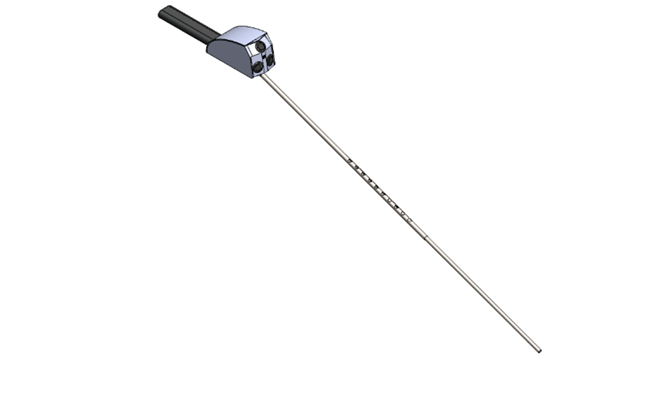
The second generation of Li-Stick represents a significant shift in philosophy. Rather than functioning solely as a proof of concept, Li-Stick V2 was designed as a commercially oriented MVP capable of supporting future deployment and expansion.
The development team focused on five key objectives:
Feedback gathered from users and stakeholders influenced multiple design decisions. Several features originally envisioned for the first prototype were simplified or redesigned to improve practicality, while new capabilities were introduced to support real-world use cases.
The result is a hybrid architecture that combines local embedded intelligence with cloud-based services and mobile application support.
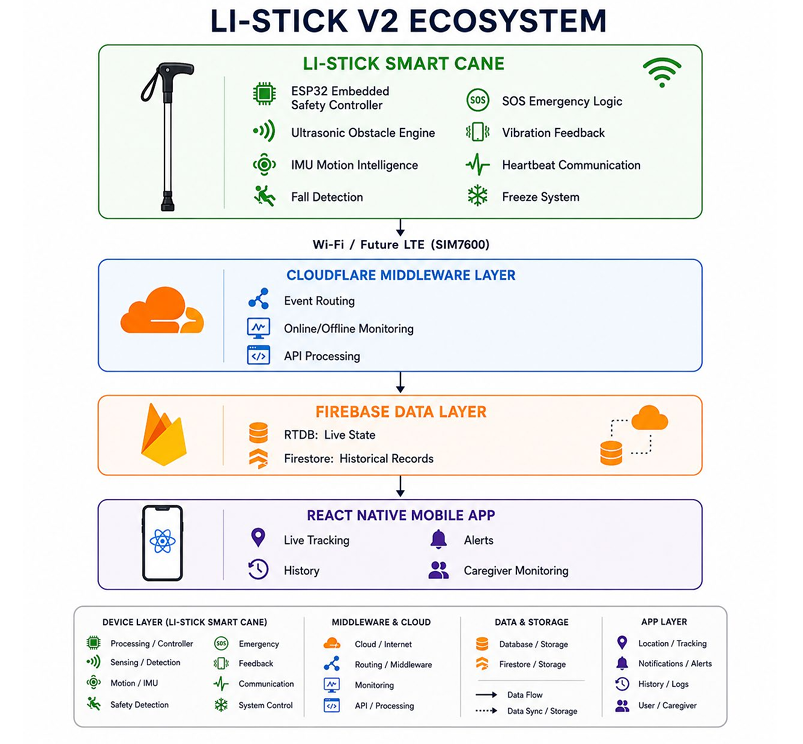
Li-Stick follows a layered architecture designed to balance safety, responsiveness, and scalability. The architecture diagrams included with this contribution illustrate how the different system components interact to create a complete assistive mobility ecosystem.
At the foundation of the system lies the Embedded Safety Layer. This layer operates locally on an ESP32 microcontroller and is responsible for all safety-critical decisions.
Obstacle detection, vibration feedback, fall detection, emergency alerts, and movement analysis are performed directly on the device. This approach ensures that core safety functions remain operational even when internet connectivity is unavailable.
The Sensor Layer provides environmental awareness through multiple ultrasonic sensors and inertial measurement units. These sensors continuously collect information about nearby obstacles, movement patterns, and user activity.
Above the embedded system sits the Connectivity Layer, which enables communication with cloud services. Current implementations rely on Wi-Fi connectivity, while future versions will incorporate LTE and GNSS functionality for greater independence and coverage.
The Cloud Layer provides real-time synchronization, event management, historical storage, and caregiver communication services. As illustrated in the architecture and data-schema diagrams, Cloudflare Workers act as middleware between the cane and Firebase services, ensuring efficient processing of live and historical data.
Finally, the Mobile Application Layer allows caregivers to monitor user status, receive alerts, review history records, and access live location information through an intuitive interface.
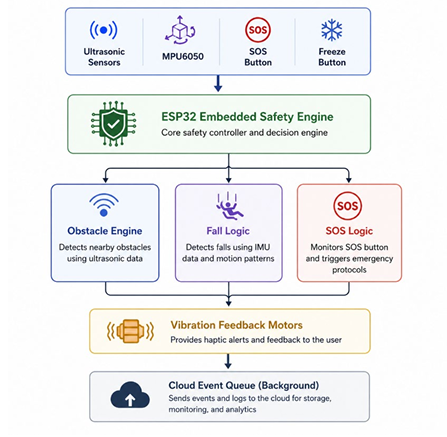
One of the most important design decisions in Li-Stick was maintaining local control over all safety-related functionality.
Many connected devices rely heavily on cloud processing, which can introduce latency and create dependency on internet connectivity. For assistive mobility applications, such delays are unacceptable. A user approaching an obstacle cannot wait for a remote server to determine whether feedback should be delivered.
For this reason, Li-Stick processes obstacle detection, vibration patterns, fall detection, and emergency triggers locally. The embedded safety engine continuously analyzes sensor data and provides immediate tactile feedback through vibration motors.
The system also incorporates movement-aware intelligence. Rather than using fixed detection thresholds, Li-Stick adapts its behavior according to walking speed, cane movement, and environmental context.
This dynamic approach improves user experience by reducing unnecessary alerts while maintaining responsiveness in critical situations.
The embedded safety architecture diagram demonstrates how sensor inputs, movement analysis, and vibration outputs interact to create a responsive and autonomous safety system.
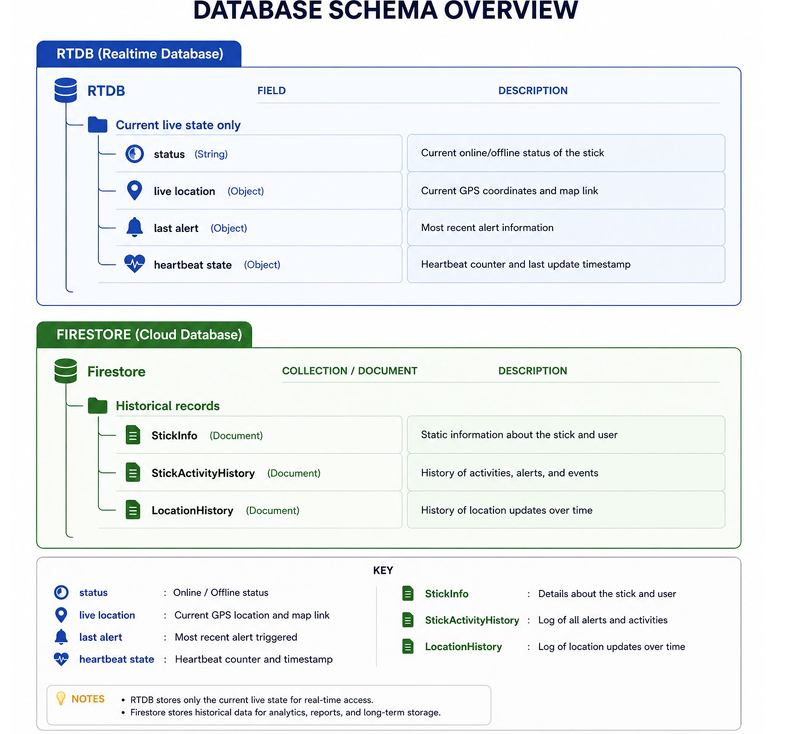
While safety decisions remain local, connectivity plays a critical role in extending the value of the platform.
Li-Stick utilizes a cloud architecture based on Cloudflare Workers and Firebase services. This architecture separates live operational data from historical records to maximize efficiency and scalability.
The data architecture diagram illustrates this separation clearly. Firebase Realtime Database is used to maintain the latest state of the cane, including connectivity status, location information, and recent alerts. Firestore is used to store historical records such as activity logs, location events, and alert history.
This design provides several advantages. Caregivers can access live information without querying large historical datasets, while historical records remain available for review, analysis, and future service expansion.
The cloud infrastructure also supports heartbeat monitoring, which enables automatic online and offline status detection. This functionality allows caregivers to determine whether the cane remains connected and operational.
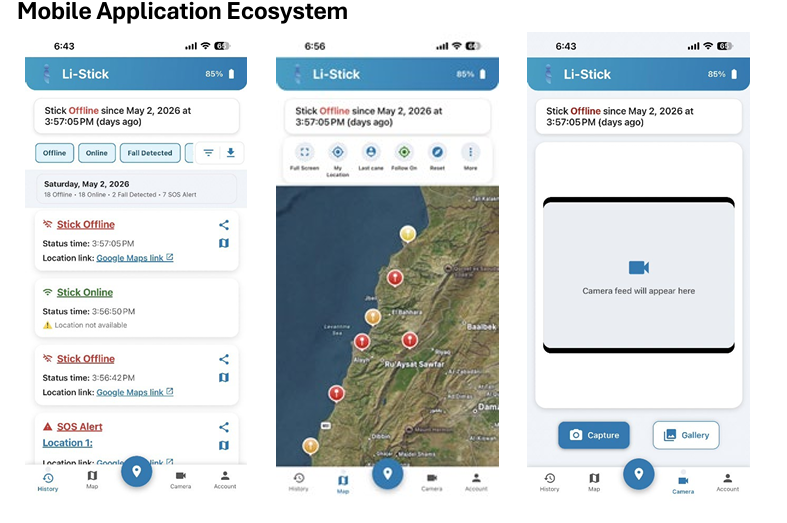
Li-Stick is not simply a smart cane; it is an integrated ecosystem that connects users, caregivers, and support services.
The mobile application serves as the primary interface for caregivers. Through the application, caregivers can view live location information, monitor connectivity status, receive emergency alerts, and review historical activity records.
The screenshots included in the MVP documentation demonstrate the current application interface and functionality. Particular emphasis was placed on simplicity, accessibility, and ease of navigation.
In addition to caregiver features, the platform includes functionality designed specifically for visually impaired users. Accessibility-focused interface-design principles guided the development process to ensure usability and inclusiveness.
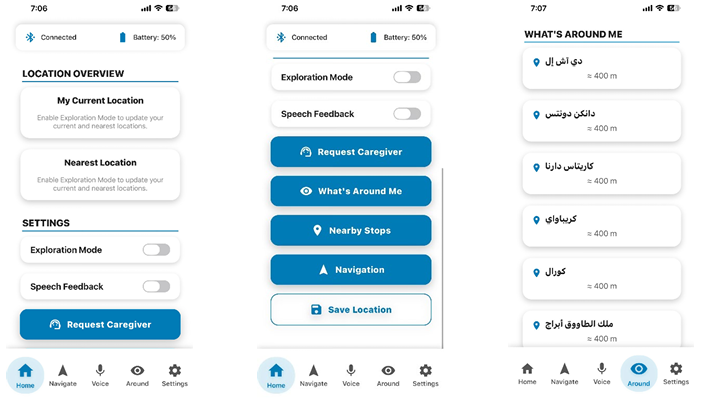
Future application releases will introduce additional features, including:
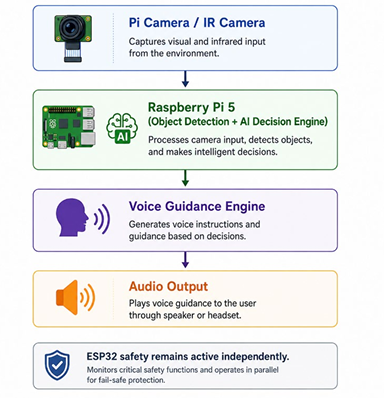
Artificial intelligence represents one of the most promising future directions for Li-Stick. However, the development team intentionally adopted a conservative approach toward AI integration.
Rather than allowing AI to replace safety functions, Li-Stick treats artificial intelligence as an enhancement layer that complements existing embedded intelligence.
The future AI architecture diagram illustrates this concept. A Raspberry Pi-based co-processor will analyze camera data using lightweight computer-vision models capable of running entirely offline.
The AI system will identify environmental contexts such as stairs, vehicles, pedestrians, crowded areas, and head-level obstacles.
Importantly, AI recommendations will remain advisory rather than authoritative. Final safety decisions will continue to be governed by the embedded safety layer.
This architecture improves reliability and ensures graceful degradation in the event of AI or connectivity failures.
The long-term vision is to provide concise contextual guidance that enhances environmental awareness while avoiding excessive or distracting information.
The journey from academic prototype to MVP revealed several important lessons.
One of the most significant challenges involved balancing innovation with practicality. While advanced technologies offer exciting possibilities, assistive products must prioritize reliability, simplicity, and user trust above all else.
Another lesson involved the importance of continuous user feedback. Features that appeared attractive from an engineering perspective did not always align with real user needs. Regular evaluation and refinement were essential in shaping the current architecture.
The team also learned that scalability should be considered from the earliest stages of development.
By designing modular architectures and separating embedded, cloud, and application layers, Li-Stick is positioned for future expansion without requiring a complete redesign.
Li-Stick demonstrates how university research and engineering projects can evolve into innovations with real societal impact.
Support from entrepreneurship initiatives, innovation programs, and technology-transfer activities played an important role in advancing the project beyond the classroom.
Participation in startup competitions and innovation programs provided valuable feedback, validation opportunities, and commercialization perspectives.
The project also highlights the importance of intellectual property awareness and structured innovation management when transitioning research outputs toward market readiness.
Through this process, Li-Stick evolved from a student engineering project into an emerging assistive technology platform with the potential for broader deployment.
The next phase of Li-Stick development will focus on refining the MVP and preparing for pilot deployment.
Planned enhancements include:
Longer-term objectives include multi-user support, advanced accessibility features, institutional deployment models, and expanded AI-assisted navigation capabilities.
The guiding principle remains unchanged: Technology should empower visually impaired individuals while remaining reliable, affordable, and easy to use.
Li-Stick represents more than a smart cane. It is an example of how engineering innovation, user-centered design, and technology transfer can converge to address real societal challenges.
By combining embedded safety intelligence, cloud connectivity, caregiver support, and future AI capabilities, the project demonstrates a practical pathway toward inclusive mobility innovation.
The experience gained throughout the development of Li-Stick highlights the importance of designing technologies around user needs, maintaining simplicity in safety-critical systems, and creating architectures capable of evolving over time.
As development continues, Li-Stick aims to contribute not only to assistive technology innovation but also to broader discussions on accessibility, inclusion, and the commercialization of research-driven solutions.