



Details
7
0
Save
Authored by Dr. Ahmad Ashaal
10 minutes
Aug 24, 2026


Authored by Dr. Ahmad Ashaal
How adaptive innovation and inclusive employment restored socio-economic participation during Lebanon's 2019–2023 economic crisis
Based on qualitative research with 18 MSME and social enterprise founders and managers, conducted by Dr. Ahmad Ashaal, August–November 2022
Lebanon's crisis at a glance
Since 2019, Lebanon has experienced one of the most severe economic collapses in modern history. The national currency lost approximately 90% of its value. Banks froze client accounts, cutting off access to savings and working capital. Chronic power blackouts, fuel shortages, and supply chain disruptions compounded unemployment and poverty at every level. Youth and female unemployment rates reached upwards of 40% by 2022. Since the Lebanese state has almost a total absence as an economic actor, MSMEs (Micro Small & Medium Sized Enterprises) and social enterprises have emerged as the major sources of economic stability, the provision of basic essential items, and support for the citizens of Lebanon.
Lebanon's crisis changed the role of business itself
When banks froze deposits, electricity disappeared for hours each day, and inflation erased salaries almost overnight, survival stopped being an individual challenge — it became a collective one. Across Lebanon, families increasingly depended on small businesses and community-driven enterprises simply to maintain daily life.
This article draws on original qualitative research with 18 Lebanese MSME and social enterprise founders and managers to argue that small businesses did not merely survive the crisis — they actively restored socio-economic participation through two connected responses: adaptive innovation and inclusive employment. Together, these mechanisms formed a resilience loop that sustained communities when formal institutions could not. Understanding how and why this happened carries important lessons for corporate finance, development policy, and innovation ecosystem design well beyond Lebanon.
Innovation looked different in Lebanon
In Lebanon, innovation became less about scaling and more about continuity. The majority of entrepreneurs used available resources to find ways to create new processes for their business (to operate), created informal support systems, and altered their operations to be able to function when there were no other formal options.
"I didn't innovate to get bigger; I was forced to innovate so that I can keep doing business." — A food producer from Beirut
All interviewees across the 18 countries/sectors reported similar examples of how they operated during crisis times. The same food producer in Beirut illustrates this, as he recreated his entire supply chain by partnering locally due to the collapse of imports. Similarly, an IT company transitioned to offering digital services to reach customers who could no longer travel. A recycling social enterprise in Byblos redesigned its collection model around intermittent electricity. In each case, innovation was not strategic — it was survival. And in surviving, these firms kept essential goods and services flowing to communities that had nowhere else to turn.
This experience also challenges an important assumption of the CSV framework — that social value can be strategically added to existing competitive activities. In Lebanon, the logic inverted: social value creation became a precondition for organizational survival. Firms that served community needs were rewarded with the local supplier networks, informal credit arrangements, and customer loyalty that kept them alive. Those who did not risked isolation from the very relationships sustaining them.
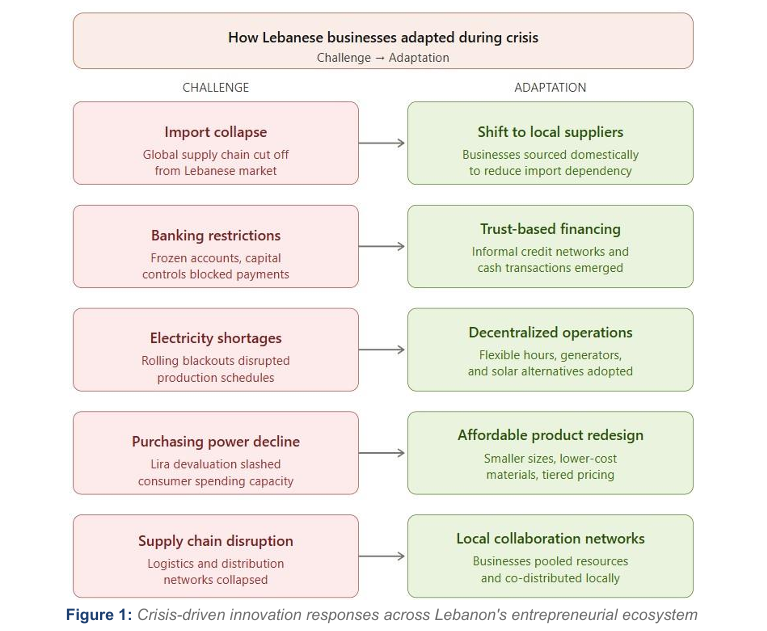
Figure 1: Crisis-driven innovation responses across Lebanon's entrepreneurial ecosystem
How Lebanese businesses adapted during crisis (Challenge → Adaptation)
Small businesses quietly became community stabilizers
Employment decisions in Lebanon's crisis firms were simultaneously financial and social decisions. Many organizations continued employing workers despite severe uncertainty. Others intentionally hired vulnerable groups — particularly youth and women excluded from collapsing labor markets. Employment became social protection, community continuity, and economic survival infrastructure all at once.
"If we stop hiring, families will fall apart." — Garment producer, Beirut
A social enterprise in the Bekaa Valley hired women and youth who had been entirely excluded from the formal labor market. By 2022, youth and female unemployment in Lebanon had exceeded 40%, making these employment decisions critical acts of social protection — filling a gap left by failing public institutions. Beyond income, participants consistently described employment as providing something equally important: dignity, identity, and a sense of belonging at a moment when both were under severe pressure.
Standard corporate finance frameworks treat employment as a cost to be optimized. The Lebanese experience reveals a different logic: the retained workforce was the primary adaptive asset. Skilled, experienced employees were the firm's capacity to respond to rapidly changing conditions. Laying off staff to cut costs in the short term would have destroyed the very capability needed to generate revenue in the following quarter — and the social legitimacy needed to sustain community relationships.
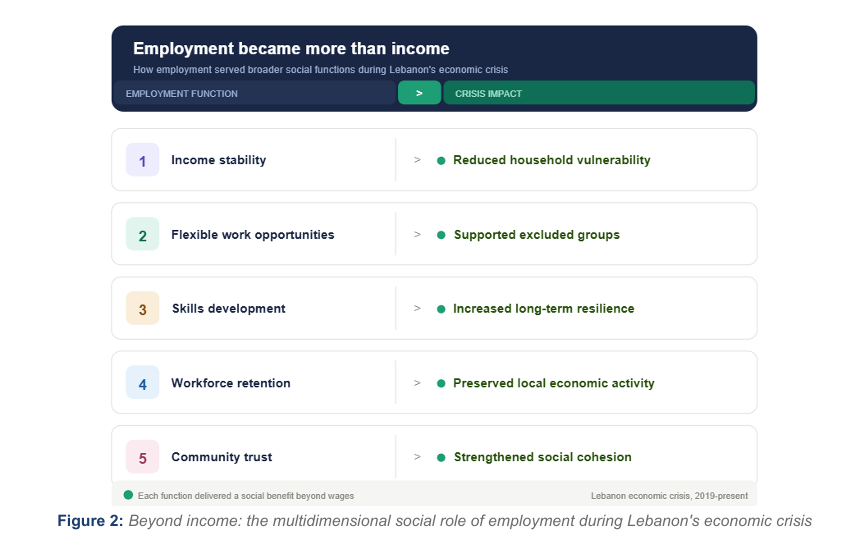
Figure 2: Beyond income: the multidimensional social role of employment during Lebanon's economic crisis
Innovation and employment reinforced each other
The most important finding of the research is that innovation and employment did not operate as separate strategic decisions. They formed a mutually reinforcing system — a resilience loop — and it is this interdependence, not either mechanism alone, that constitutes the engine of economic recovery under institutional fragility.
Businesses needed innovation to preserve jobs. Simultaneously, employees' experiences, flexibility, and problem-solving ability provided businesses with an opportunity to continue evolving in response to pressures. The two mechanisms locked together into a self-reinforcing cycle that emerged not by design but by necessity.
"Without employees, we cannot keep adapting. Our team is what allows us to continue innovating." — General Manager, MSME
This also has direct implications for how lenders and investors assess firm viability. A firm retaining marginally profitable operations to maintain its workforce and community legitimacy may appear weaker on a standard balance sheet than one that has cut costs aggressively — while being substantially more resilient in practice. Social capital, community embeddedness, and workforce retention are not soft metrics. In fragile economies, they are the balance sheet.
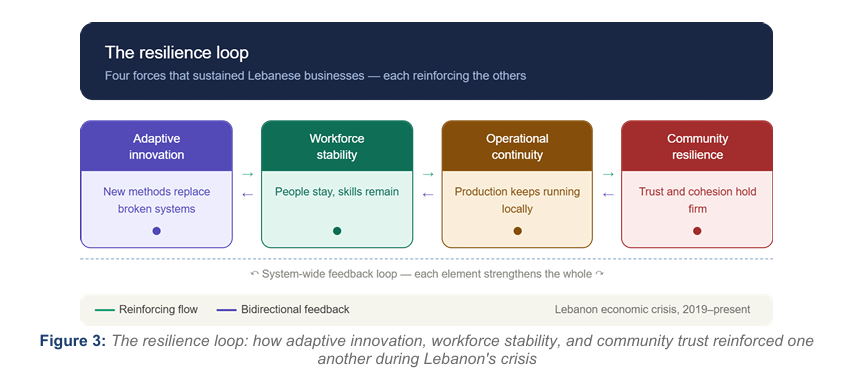
Figure 3: The resilience loop — how adaptive innovation, workforce stability, and community trust reinforced one another during Lebanon's crisis
But resilience has limits
Despite these adaptive efforts, Lebanese enterprises faced enormous constraints. Many struggled to balance business survival, employee protection, social mission, and growing community expectations simultaneously. Resource shortages — financial capital, raw materials, reliable electricity — repeatedly forced difficult trade-offs.
"Sometimes we innovate just to stay alive, not to help others." — MSME founder
The tension between the firm's survival and its mission is not due to an intention to fail. The tension is caused by the collapse of institutional support; therefore, the burden of social stability falls upon the organization, which was created to support society, not replace it. Therefore, it is necessary to recognize this difference when creating policies. These firms require support structures (i.e., funding, access to resources) rather than simply acknowledging their existence.
What this means for corporate finance and innovation policy
Lebanon's experience offers four clear lessons for policymakers, funders, development finance institutions, and ecosystem builders working in fragile or crisis-affected economies:
1. Innovation is not only technological
Lebanese entrepreneurs innovated through local sourcing, product redesign, and trust-based networks — not apps or patents. Policy and finance instruments must recognize grassroots adaptive innovation as equally valid and equally deserving of support as technology-driven innovation.
2. Small businesses are strategic social actors
The 18 organizations studied were not just surviving — they were absorbing displaced workers, supplying communities with essentials, and filling gaps left by collapsed public services. They deserve to be recognized, measured, and supported as critical social infrastructure, not as marginal economic actors.
3. Financing systems must reflect informal realities
Formal credit channels were largely inaccessible during the crisis. Businesses relied on informal trust-based financing and deferred payments. Ecosystem support — grants, microfinance, deferred repayment, payroll protection — must be designed around this reality, not around assumptions of functional banking.
4. Trust and relationships are the infrastructure
When banks, supply chains, and institutions failed, relationships held. Local supplier networks, community reputation, and employee loyalty became the operating system of the economy. Policy should actively invest in relationship infrastructure alongside physical and financial infrastructure.
Beyond survival
The Lebanon crisis showed that, despite an institutionally weakened environment, innovation can persist. The ability of Lebanese MSMEs and social ventures to innovate, cooperate, support one another, and rebuild themselves has been shown not to be attributable to favorable circumstances.
These organizations innovated and supported their own communities while sustaining some level of economic activity from the bottom up rather than waiting on the system to stabilize. For corporate finance, the lesson is clear: value creation is always relational, even when stable institutions make it appear otherwise. When those institutions disappear, the relational foundations become visible — and the firms that understood this survived.
That is not just resilience. That is leadership — and it deserves to be recognized, studied, and supported.
References
OECD (2022). SME and Entrepreneurship Policy in the Middle East and North Africa. OECD Publishing.
Porter, M.E. & Kramer, M.R. (2011). Creating shared value. Harvard Business Review, 89(1–2), 62–77.
Sen, A. (1999). Development as Freedom. Oxford University Press.
UNDP (2023). Social Entrepreneurship and Inclusive Development in Fragile Contexts. United Nations Development Programme.
World Bank (2021). Lebanon Economic Monitor: The Great Denial. World Bank Group.
Insights adapted from qualitative interviews with 18 Lebanese MSME and social enterprise founders and managers, conducted August–November 2022 during Lebanon's economic crisis (2019–present).